Skills No One Taught Me: What I Learned by Starting a PhD Abroad
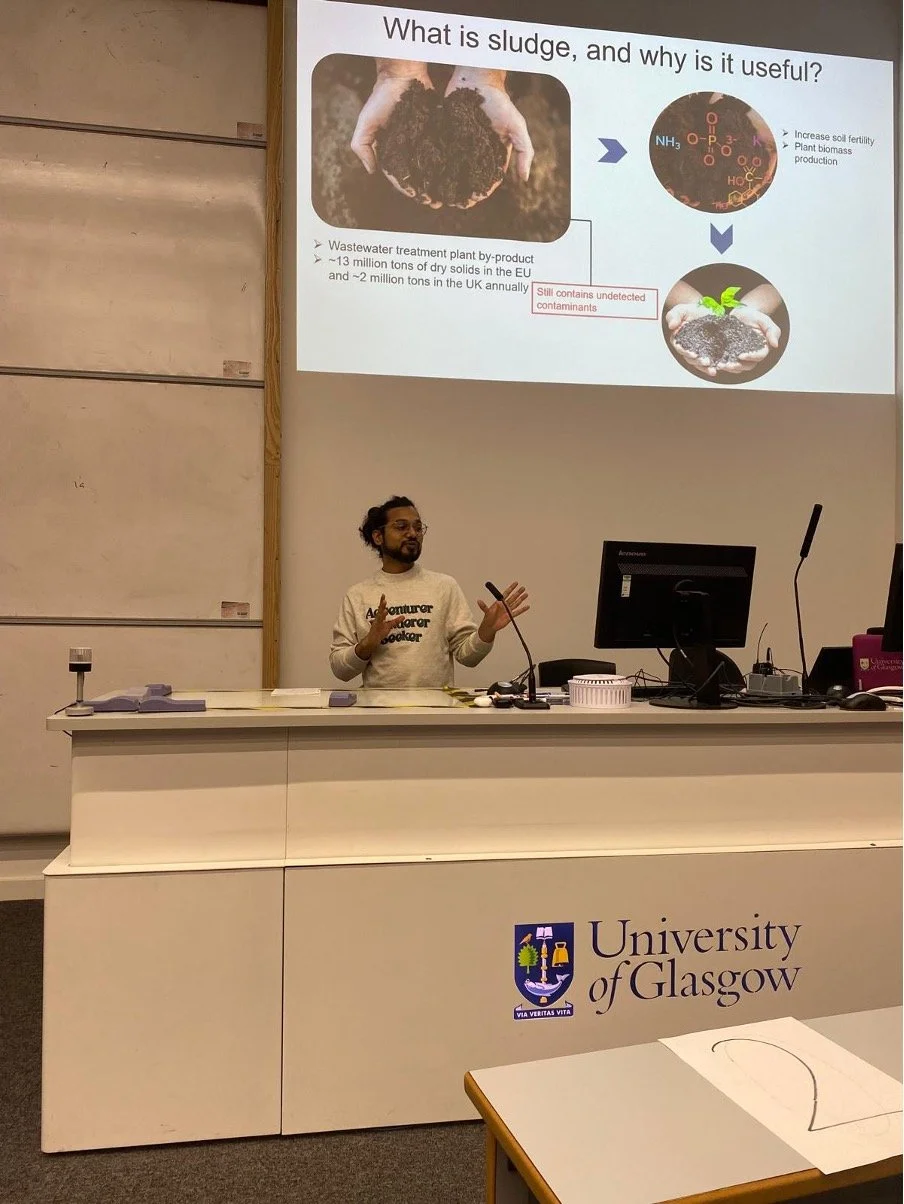
Nitin presenting his work
Nitin Kumar is a Marie Skłodowska-Curie doctoral researcher at the University of Glasgow, exploring environmental sensing while navigating the challenges and opportunities of conducting research abroad.
I started my PhD journey on May 16th, 2024, in the UK. I thought my biggest challenge would be chemistry.
I was wrong.
Coming from India, I expected to spend most of my time learning scientific concepts, running experiments, and reading research papers. Instead, I quickly realised that many of the most important skills required for a PhD are never formally taught.
Like many international students, I was adapting to a new country, a different academic culture, and a language I used every day, but that was not my first. Back home, I considered myself an extrovert. I enjoyed discussions, asked questions freely, and had no hesitation speaking up when I was unsure about something. Yet after moving abroad, I gradually became quieter and more hesitant.
One challenge that surprised me was communication. It was not that I could not speak English, but communicating in an academic and professional environment felt very different. Often, I knew what I wanted to say, but by the time I had formed the sentence in my head, the conversation had already moved on. Other times, I thought I had understood instructions correctly, only to discover later that I had misunderstood an important detail.
One of the biggest lessons came during my first year. My supervisor had asked me to prepare several stock solutions for an experiment. Unfortunately, I was not ready on time. Understandably, he was frustrated. We discussed what had happened; I apologised and promised to do better. The very next day, I made another mistake while preparing samples.
At the time, it felt like a major failure.
Looking back, I realise the real problem was not the experiment itself. The problem was communication.
I had not been asking questions when I was unsure. I often assumed that I had understood enough to continue, or worried that asking for clarification would make me look unprepared. Instead, my silence created confusion and mistakes that could have been avoided.
After an honest discussion, my supervisor explained something that has stayed with me ever since:
"If you do not understand, ask. That is what we are here for."
It sounds simple, but it completely changed my research approach.
Since then, I have learned that asking questions is not a sign of weakness. It is a professional skill. Research is full of uncertainty, and nobody expects a PhD student to know everything. What matters is being willing to learn.
Another important lesson came from my colleagues. In discussions, I often assumed that more experienced researchers were always right. One colleague told me something that surprised me: sometimes you must disagree and speak for yourself. Research is built on discussion, debate, and critical thinking. Learning how to challenge ideas respectfully is just as important as learning laboratory techniques.
My colleagues also helped me understand instruments, laboratory techniques, and ways of working that were completely new to me. Through these experiences, I realised that research is a collaborative process. Success does not come only from methods, instruments, or papers, but also from the people around you who are willing to teach, support, and challenge you.
To overcome these challenges, I started saying yes to opportunities that would have previously made me uncomfortable. Whether it was giving presentations, writing blogs, participating in project meetings, or speaking to audiences outside my research area, I tried to view each opportunity as practice rather than a test.
I am fortunate to be part of the INCLUE-Horizon MSCA Doctoral Network (Developing innovative, circular solutions for wastewater treatment sludge), which encourages researchers to communicate their work beyond the laboratory. These opportunities have helped me become more confident and have improved my ability to explain complex ideas to different audiences. While I still get nervous before presentations, each experience becomes a little easier than the last.
Perhaps the biggest misconception I had before starting my PhD was that success depended only on scientific ability.
Today, I see things differently.
A PhD is not only about becoming a better researcher. It is about becoming a better communicator, collaborator, and problem solver. It is about learning how to ask for help, work with people from different backgrounds, and navigate uncertainty.
If I could give one piece of advice to new doctoral researchers, especially those moving to a new country, it would be this:
Ask questions.
Ask when you are confused.
Ask when you need help.
Ask when you think everyone else understands except you.
Because the most valuable lesson I learned during my PhD was not a laboratory technique or a scientific concept. It was learning that communication, like research itself, improves through practice. Sometimes the skills that shape us most are the ones nobody explicitly teaches.