
Maria Izzo is a Doctoral Candidate in Health and Social Policy in the School of Environmental and Social Sustainability
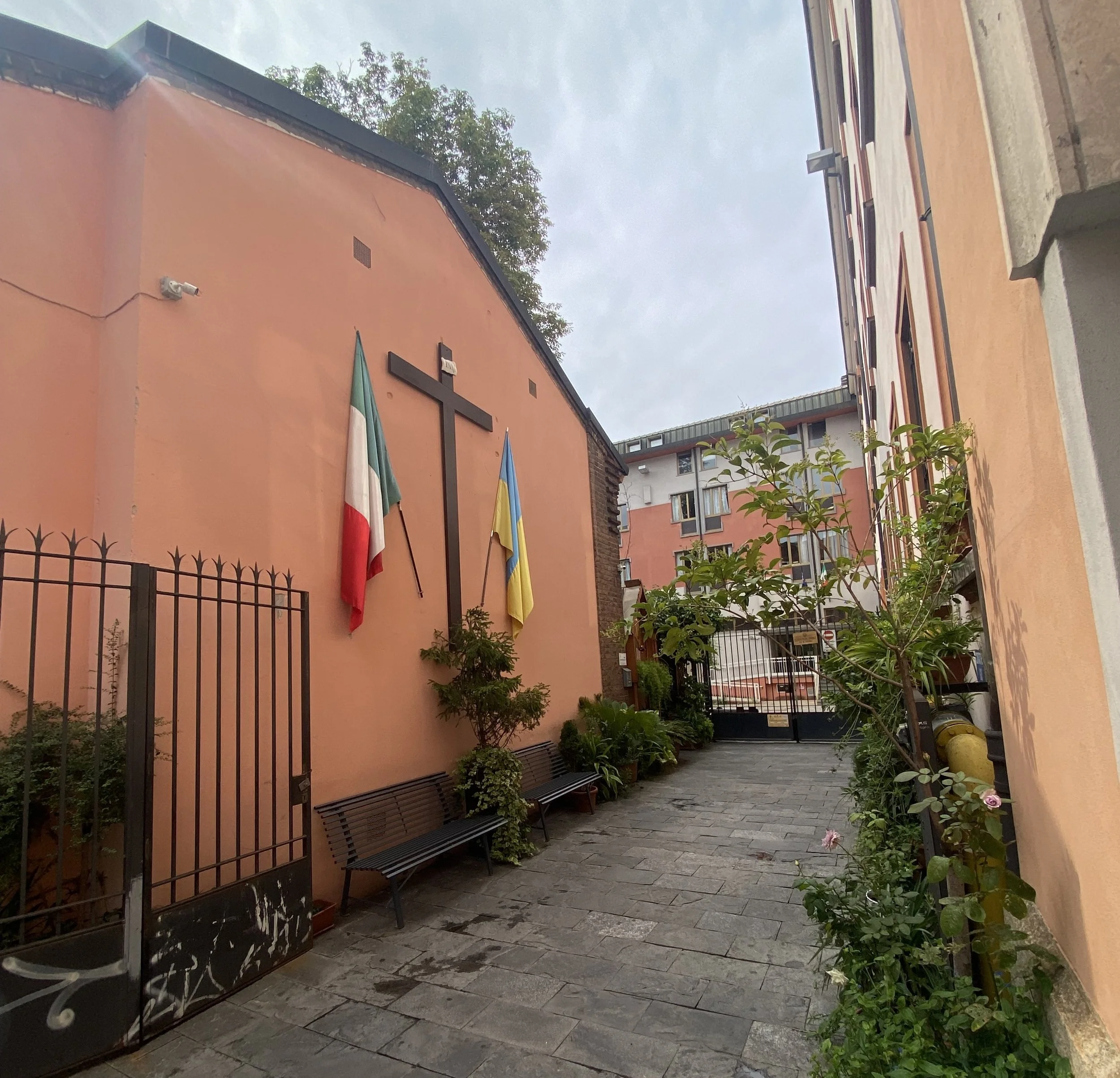
Ukrainian place of interest in Milan.
Between July 2023 and January 2024, I conducted fieldwork in Naples and Milan to collect data for my PhD research, a qualitative study examining access to social protection among Ukrainian care workers in Italy. The project, carried out in the context of Russia’s 2022 invasion of Ukraine, combined fifty-five semi-structured interviews with participant observation. Although the study primarily focused on migration, ageing, and care work, the ongoing war meant that language—particularly the choice between Russian and Ukrainian—quickly became an equally central theme. This blog post reflects on how multilingual communication shaped the research process and argues that navigating Italian, Ukrainian, and Russian in politically sensitive circumstances required ongoing reflection and continuous adjustments to ensure ethical sensitivity.
Communication lies at the very core of qualitative inquiry, which is built on conversation (Kvale and Brinkmann, 2015). It depends on the relationships we form, the stories people share, and the meanings we co-construct through dialogue, and often across languages. In this context, language is not only a technical tool, but also a social practice through which trust, identities, and power relations are negotiated (Watson, 2004). Therefore, for researchers working in multilingual and politically sensitive contexts, linguistic choices can be both ethically and emotionally complex (Gibb et al. 2020).
Ukrainians are generally bilingual in Russian and Ukrainian. However, after February 2022, the choice between these two languages became deeply politicised, with many Ukrainians shifting away from Russian (Maxwell et al., 2024; Racek et al., 2023). I am an Italian native speaker, fluent in Russian but not in Ukrainian, which I knew could become a barrier when approaching potential interviewees I was also aware that Italian would not always be a viable option during interviews. Many migrant care workers, due to their work in private homes, have limited opportunities to practice the language.
To overcome these challenges, I took private Ukrainian lessons from March to June 2023, though the short course was not enough to achieve fluency. I translated key documents including the consent form, privacy notice, and participant information sheet into Italian, Russian, and Ukrainian to ensure accessibility. Yet preparation could not resolve the most delicate issue which was how I could best ask participants about their preferred language. How could I address their relationship with Russian, given the emotional and political weight of that choice? I began fieldwork without a clear answer, aware that every conversation would require careful navigation.
In many cases, support came from mediators such as NGO workers who introduced me to participants and, in doing so, often shared information about their language preferences. When mediation was not possible, I introduced myself broadly as someone with a background in Slavic languages rather than explicitly mentioning Russian. This approach often allowed participants to decide which language to use, and some said they preferred speaking in Russian.
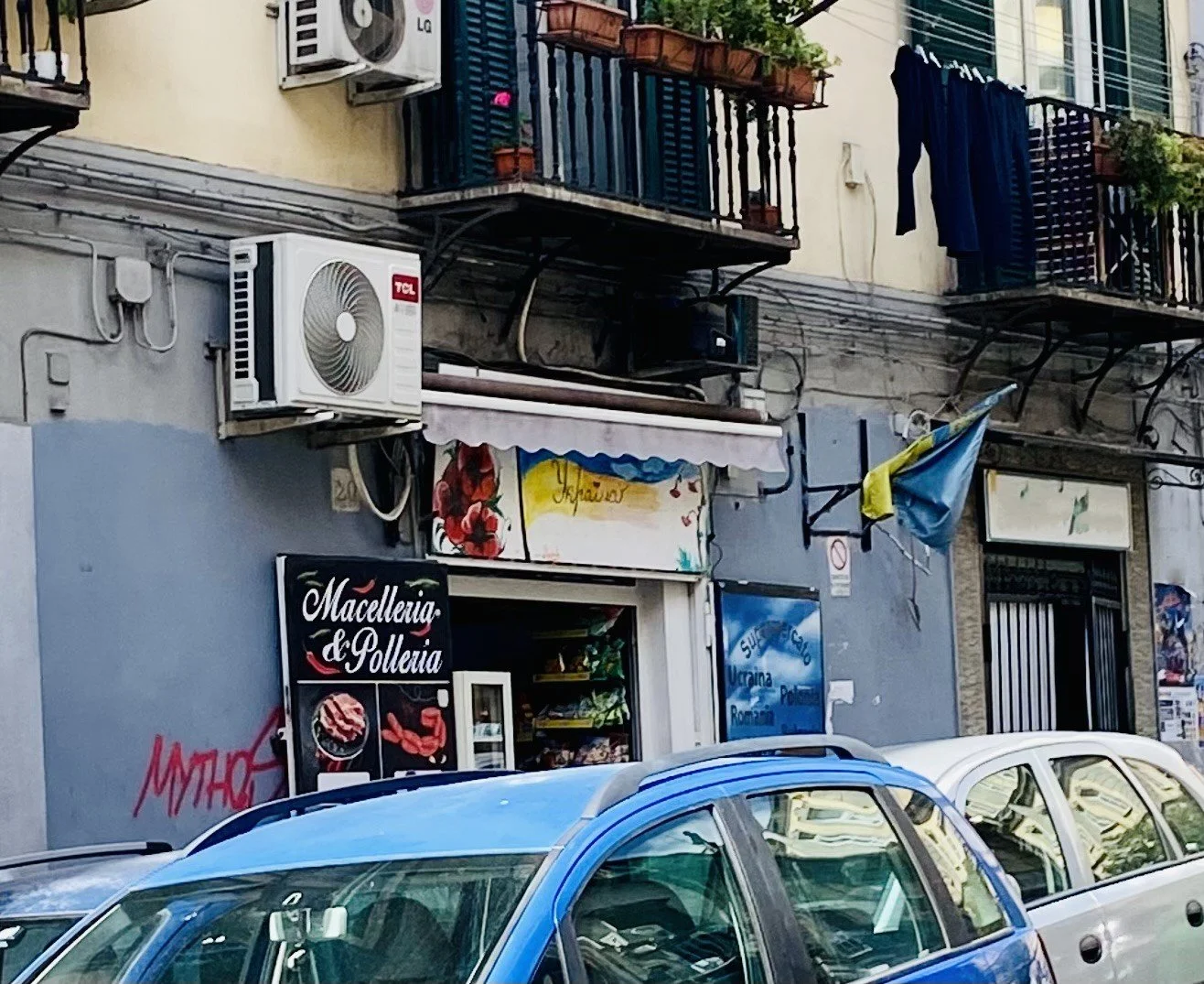
Ukrainian place of interest in Naples
As fieldwork unfolded, local context also began to play an unexpected role. In Naples, where I began my fieldwork, many participants were reluctant to use Russian but also struggled with standard Italian. They often cited the local Neapolitan dialect as an obstacle to their language learning. In Milan, by contrast, participants tended to be more fluent in Italian, and all interviews were conducted in that language.
To improve communication, I experimented with different strategies. Translating the interview guide into Ukrainian helped me ask questions, but following and transcribing responses proved difficult. I also simplified my Italian, replacing technical terms such as “welfare,” “social protection,” or “third-sector” with more everyday expressions: pensions, going to the doctor, or asking for help when in trouble.
Over time, I learned to embrace the messiness of multilingual communication. Many interviews moved fluidly between Italian, Russian, and Ukrainian — and even different dialects. One participant in Naples expressed her feelings about the war by switching languages mid-sentence: “Tse e zhakh (this is horror), tse e bil’ (this is sorrow) … it is painful to see soldiers killed and left on the ground.” Another participant in Milan used racchetti (literally “rackets” in Italian) to mean rackety (“missiles” in Ukrainian/Russian). These hybrid forms might seem confusing at first, but within the multilingual reality of my research, they made perfect sense.
Working multilingually means balancing preparation with improvisation and planning for structure while accepting uncertainty. It often involves moving fluidly across languages rather than committing to one and embracing hybrid forms of expression. Transcribing such interviews is time-consuming, and software tools often struggle with mixed-language data. Yet these conversations are also richer. They capture emotion, belonging, and the “in-between” spaces created by migration. For researchers, the challenge is not to simplify this complexity but to engage with it ethically and respectfully, recognising that communication in the field is about more than linguistic accuracy. It is about openness, sensitivity, and mutual understanding.
References:
Gibb, Robert, Annabel Tremlett, and Julien Danero Iglesias. 2020. Learning and Using Languages in Ethnographic Research. Vol. 2.;2; Bristol: Multilingual Matters Ltd.
Kvale, Steinar, and Svend Brinkmann. 2015. InterViews: Learning the Craft of Qualitative Research Interviewing. Third edition. Los Angeles: Sage Publications.
Maxwell, Olga, Iryna Skubii, and Natalia Kudriiavtseva. n.d. ‘The Politics of Language in Wartime Ukraine’.
Racek, Daniel, Brittany I. Davidson, Paul W. Thurner, and Göran Kauermann. 2023. ‘The Politics of Language Choice: How the Russian-Ukrainian War Influences Ukrainians’ Language Use on Twitter’. arXiv Preprint arXiv:2305.02770.
Watson, Elizabeth E. 2004. ‘“What a Dolt One Is”: Language Learning and Fieldwork in Geography’. Area 36(1):59–68. http://www.jstor.org/stable/20004358.