Turning the Page: The different ways of overcoming uncertainty & transition periods
Source: The Author
Dr. Zein Al Maha Oweis is a Research Assistant at Royal Holloway. She recently graduated with a PhD in Media and Cultural Policy from the University of Glasgow. Before starting her role at RHUL, Zein shares how sometimes you need to sit in uncertainty and transition periods before jumping into your next role.
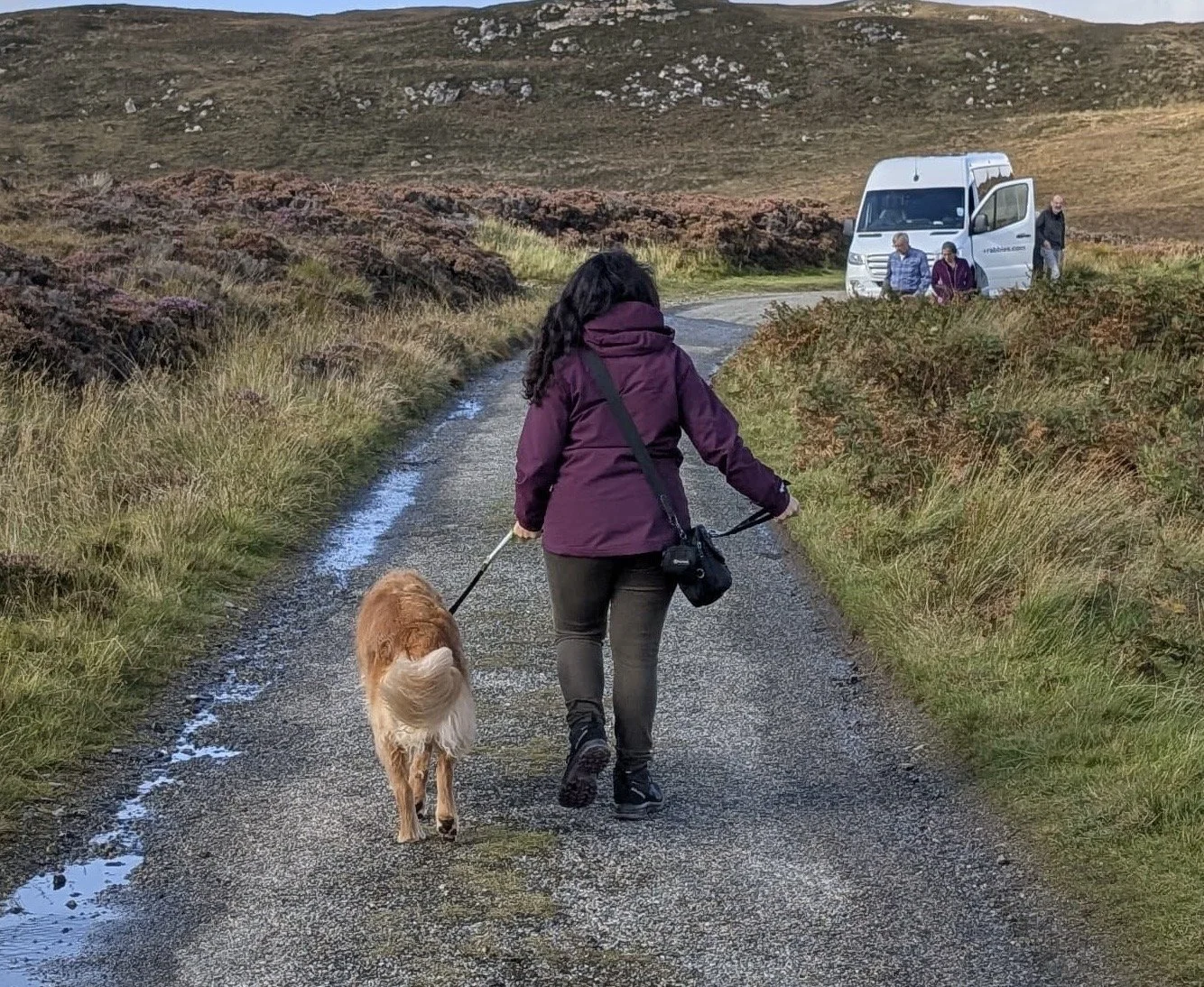
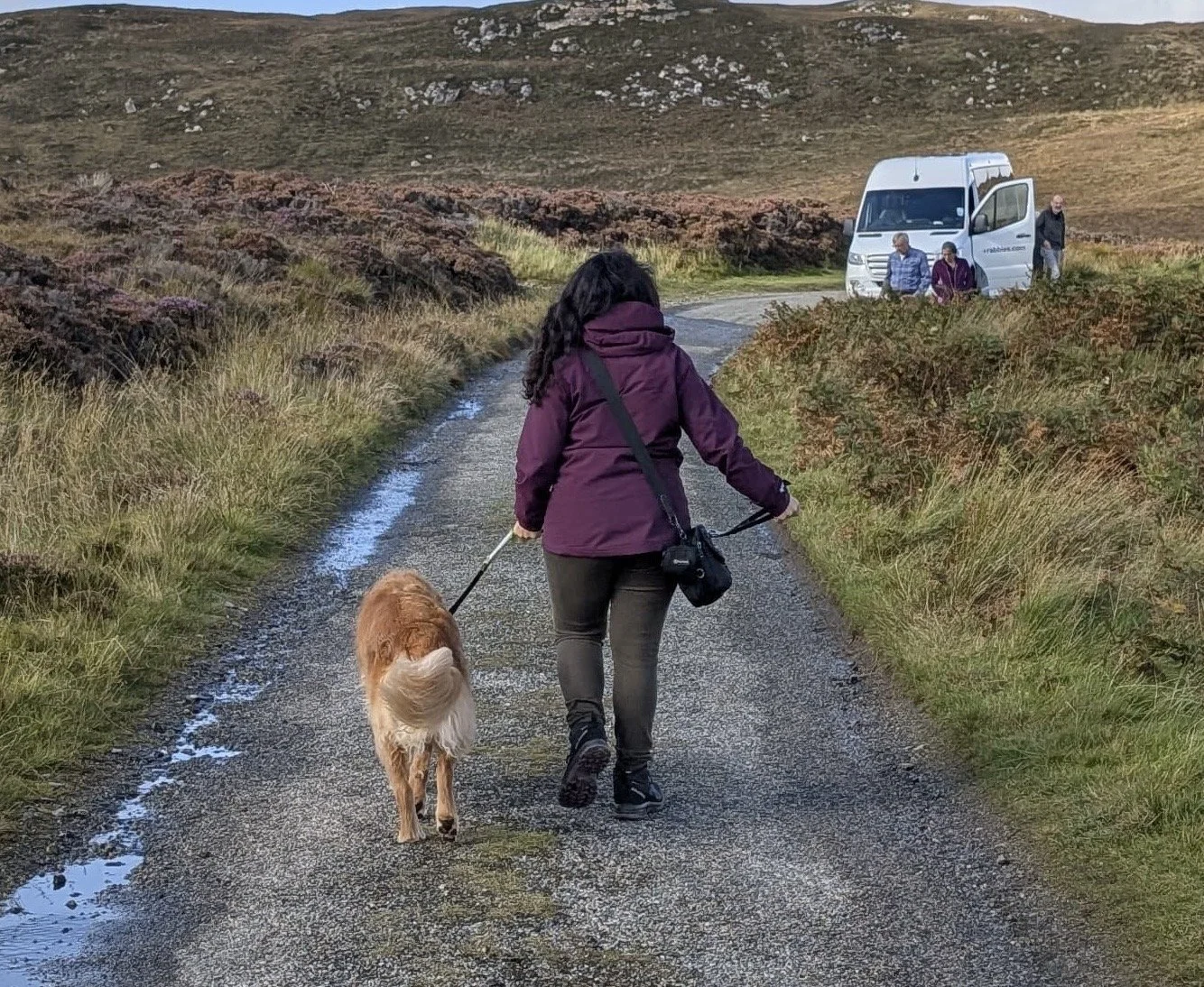
Standing in front of The Bridge to Nowhere on the breathtaking Isle of Lewis last September, I began to wonder about what life after my PhD would look like. Do we all have that moment when we panic about what is going to come next? Yes, I had that after I submitted my thesis last August and waited for the email to come from the College of Arts with my VIVA date. A reoccurring question swirled in the back of my mind: How will I be able to sit in that uncertainty without feeling lost? I have never been comfortable sitting in an environment surrounded by uncertainty. Yes, I have had to adapt through it, but I have never been comfortable with these transition periods.
As I look towards the other side of the bridge, the one that my guide dog Mitch just crossed over, I think about what’s next. Bridges symbolise pathways that connect us between the past and present or future. To me, that bridge was a turning point that gave me a wake-up call that my transition period was looming closer.
Fast forward to this May, when I submitted my corrections before my June graduation and that transitional period knocked on my door. The panic, the fear, wrapped itself around my body like tendrils latching onto me. For a person undergoing sight loss, I dread transition periods because I hate sitting in these uncertain moments. Some of us enjoy them because we can take time off and do things we have put on hold since our PhD journeys started, such as read a long-awaited romantic novel, listen to a favourite voice actor through your headphones while walking around the Scottish Highlands, go on a long-awaited trip around Europe or declutter the house.
Transition periods mean that I have my feet off the ground with no stepping stones to hold onto and for most that is the case. As soon as I hit the submit button, I knew my time as a PhD researcher was over. As much as I would love to remain a student, I had to close that chapter and turn the page to a new one. So, I decided to keep myself busy to pass the time while applying to fellowships, post-docs, researcher and industry jobs.
I came up with a bucket list of activities and tasks to do to keep myself busy as I waited for this transitional period, no matter how long it was, to pass by, I know there are many ways to get over that looming fear of not being able to find a job or not being able to sit still on the couch and relax. Anyone who has passed the threshold of submitting their thesis and waiting for what’s next will understand how difficult it is to relax after a PhD.
For someone with an overthinking brain like mine, I needed to find ways to quiet my workaholic brain. So, here are some things I did to ease that uncertainty or that transition period:
Fuelling my artistic streak: I come from a family of artists of all kinds. One thing I loved to do since I was sixteen was collect stamps from around the world and I have a whole collection of them. During the evening, I began to listen to an audiobook and decided to create a scrapbook of all my stamps, finding them a new place to call home. I was able to relax the swirling thoughts in my head while glueing stamps into a new book.
The Travelling Scholar: Indulging my travel bug soul, I fell back to one of my favourite hobbies: photography. As I travelled around the UK with my trusty guide dog Mitch, I began to take pictures of my experiences, adding my own flair to them. Having no peripheral vision, I began taking pictures as a way of showing others how I see the world around me. I started a travel blog on Instagram as a way of sharing sensory experiences with anyone who wanted to join our adventures. At the same time, I realised how much I enjoyed writing about these experiences and decided to write a book, which will be published soon. You can follow my adventures on @_the_traveling_scholar.
Adapting to uncertainty: In the evenings, or when the sun would set, uncertainty, nerves and anxiety would start to tug at me while I sat on my couch overthinking everything. This feeling is normal when you have closed a door and are opening a new one. During this time, I would reach out to family and friends to chat or put the TV on and binge old series. The uncertainty remained. It was during a phone call with my sister one day that jolted me from this negative haze. She pointed out that I was not myself and asked me one question “Is it life or death?”. I would usually answer no and she would respond, “Then what is meant for you would not pass you”. After that phone call, I realised that even though things are out of sorts, no routine and uncertain, I am still safe, in good spirits and have no major panics to worry about. The panic and nerves began to drift away. I took a pen and paper and wrote down a mini bucket list of things I wanted to do before I jumped into a new role. I began to tick these off slowly each day which helped the uncertainty slip away. I began to wake every day excited for what task, or hobby or book I was going to tackle next on my list.
March to your own rhythm: After finishing my PhD, the bubble known as my routine crumbled, which made me feel uncertain and panicky, but mostly lost. I felt as if I lost my mojo, my spark and motivation. Some of us can bounce back instantly even without a routine, while others, like me, depend on routine to keep us moving forward. After a couple of days of that lost feeling, I decided to create my own routine. So, I went back to the drawing board and drew a new routine, which I knew would put me back on track and get myself and my guide dog back on solid ground. This routine brought my magic back into my body and gave me a purpose to wake up in the morning, get out, walk and do all the things I used to when I was doing my PhD.
So, as I stand in front of another bridge, this one on the path surrounding the Linlithgow Palace grounds, I don’t feel uncertain anymore about crossing to the other side like I did when I was on the Isle of Lewis last year. I know that with uncertainty we have no idea of where our paths will go or where we will end up, but that question of what’s next is not too scary anymore: it is more exhilarating.